

Edible Insects Market Expands as Sustainable Protein Demand Accelerates Worldwide
edible insects market
The global edible insects market is projected to grow from US$2.4 billion in 2026 to US$3.9 billion by 2033, at a 6.8% CAGR.
LONDON, UNITED KINGDOM, July 12, 2026 /EINPresswire.com/ -- The global edible insects market is entering a new phase of commercial growth as governments, food manufacturers, and consumers increasingly recognize insects as a sustainable source of protein. According to recent market analysis, the industry is expected to grow from US$2.4 billion in 2026 to approximately US$3.9 billion by 2033, registering a compound annual growth rate (CAGR) of 6.8%. Rising demand for environmentally friendly food production, expanding regulatory approvals, and growing acceptance of alternative proteins continue to strengthen long-term market prospects across developed and emerging economies.
Download Your Free Sample & Explore Key Insights: https://www.persistencemarketresearch.com/samples/11491
Sustainability Drives Industry Growth
One of the strongest growth drivers is the exceptional sustainability profile of edible insects compared with conventional livestock. Insects require significantly less land, water, and feed while generating substantially lower greenhouse gas emissions. The Food and Agriculture Organization has consistently highlighted edible insects as an environmentally responsible protein source capable of supporting future food security. As governments promote sustainable agriculture and climate-friendly food systems, insect farming is receiving greater policy support, encouraging investments in commercial production facilities and innovative processing technologies worldwide.
Regulatory Progress Opens New Opportunities
Regulatory approvals have significantly improved market access over the past few years. European authorities have approved several insect species for human consumption under novel food regulations, while North American regulators have maintained a favorable environment for edible insect products. These developments have enabled manufacturers to introduce insect-derived ingredients into snacks, bakery products, protein bars, pasta, nutritional supplements, and specialty foods. Regulatory clarity has also increased investor confidence, encouraging expansion across both food and feed industries.
Consumer Acceptance Continues to Improve
Growing awareness of health, nutrition, and environmental sustainability is encouraging consumers to explore alternative protein sources. Younger generations, particularly environmentally conscious shoppers, are showing increasing willingness to purchase foods containing insect protein when presented in familiar formats such as powders, protein bars, crackers, and baked products. Manufacturers continue investing in product development that minimizes the visual appearance of insects while emphasizing nutritional benefits, helping overcome psychological barriers that have traditionally limited consumer acceptance in Western markets.
Get Custom Insights Designed for Your Business: https://www.persistencemarketresearch.com/request-customization/11491
Animal Feed Creates Major Commercial Potential
Beyond human consumption, animal feed and aquaculture represent one of the largest commercial opportunities for edible insect producers. Insect meal offers a sustainable alternative to conventional fishmeal and soybean protein used in livestock and aquaculture feeds. Growing pressure on global fishmeal supplies has encouraged feed manufacturers to adopt insect-derived ingredients. Regulatory approvals allowing insect proteins in poultry, pig, and aquaculture feed have further strengthened market demand and encouraged large-scale production investments across Europe, Asia, and North America.
Segment Highlights
Beetles, particularly mealworms, currently represent the leading insect category, accounting for approximately one-third of global market demand. Their high protein content, favorable nutritional profile, and efficient farming characteristics make them attractive for industrial production. Crickets and grasshoppers are expected to record the fastest growth due to rising use in protein powders and functional foods. Powder remains the dominant product form because it integrates easily into existing food manufacturing processes while reducing consumer hesitation associated with whole insect consumption. Business-to-business sales continue to dominate industry revenues through ingredient supply agreements.
Regional Market Trends
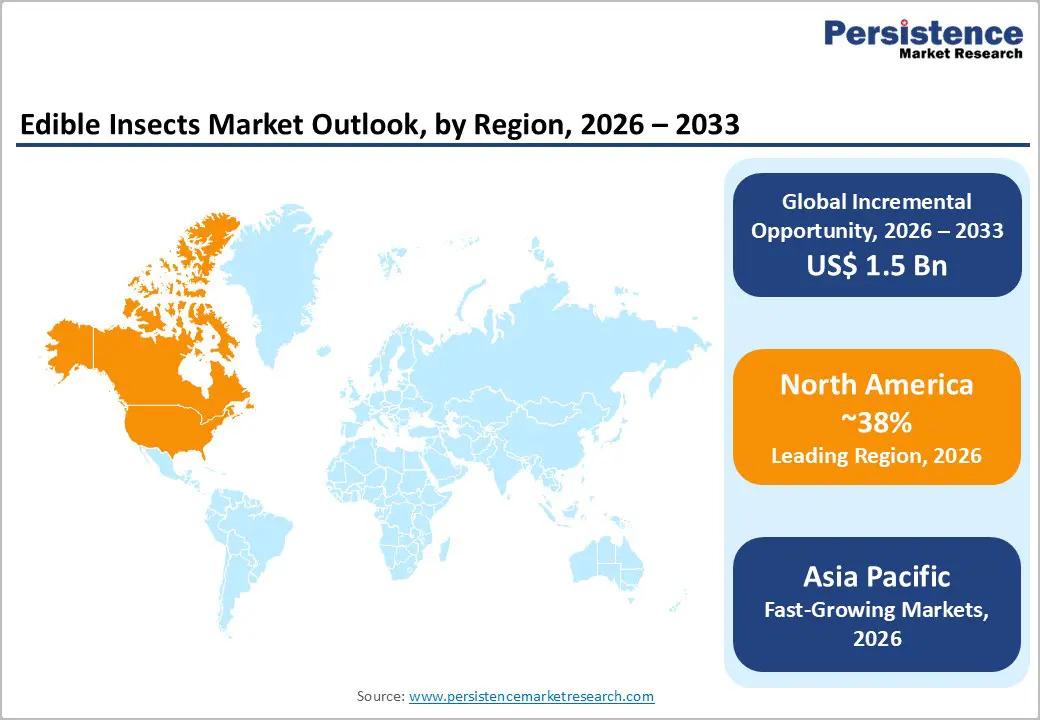
North America currently leads the global edible insects market with roughly 38% market share, supported by a strong alternative protein ecosystem, expanding retail availability, and favorable regulatory conditions. Europe remains one of the fastest-growing markets following multiple approvals for edible insect products and increasing sustainability initiatives. Asia Pacific combines centuries of traditional insect consumption with rapidly expanding commercial production. Thailand's extensive cricket farming industry and China's investment in insect protein for aquaculture continue strengthening the region's production capacity and export potential.
Checkout Now & Download Complete Market Report: https://www.persistencemarketresearch.com/checkout/11491
Market Segmentation
By Insect Type
Crickets and Grasshoppers
Beetles (Mealworms)
Caterpillars
Ants, Bees, and Wasps
Others
By Form
Whole
Powder
Specialty Food Ingredients
By Distribution Channel
B2B
B2C
By Regions
North America
Europe
East Asia
South Asia & Oceania
Latin America
Middle East & Africa
Competitive Landscape and Outlook
Competition within the edible insects market continues to intensify as companies expand farming capacity, improve automation, and develop innovative food ingredients for mainstream consumers. Strategic partnerships with food manufacturers, retailers, and animal feed producers are becoming increasingly important for market expansion. Recent regulatory approvals in Europe, Singapore, and other regions have further accelerated commercialization opportunities.
Although challenges including consumer perception, allergen labeling requirements, and regulatory compliance remain, industry participants remain optimistic that continued technological innovation, education campaigns, and supportive public policies will drive broader acceptance. With sustainability, nutrition, and food security becoming central priorities worldwide, edible insects are expected to play an increasingly important role in the future global protein market, supporting steady industry expansion throughout the forecast period and beyond.
Read Related Reports:
Sourdough Market: The sourdough market is projected to reach US$8.2 Bn by 2033, up from US$4.9 Bn in 2026, with a 7.6% CAGR, driven by demand for artisanal bakery products.
U.S. Yogurt Market: The U.S. yogurt market is projected to grow from US$10.6 Bn in 2026 to US$16.2 Bn by 2033, fueled by rising health-conscious consumption.
Persistence Market Research
Persistence Market Research Pvt Ltd
+1 646-878-6329
email us here
Visit us on social media:
LinkedIn
Instagram
Facebook
YouTube
X
Legal Disclaimer:
EIN Presswire provides this news content "as is" without warranty of any kind. We do not accept any responsibility or liability for the accuracy, content, images, videos, licenses, completeness, legality, or reliability of the information contained in this article. If you have any complaints or copyright issues related to this article, kindly contact the author above.
