

Molecular Cytogenetics Market to reach USD 8.52 Billion by 2035 at 10.15% CAGR
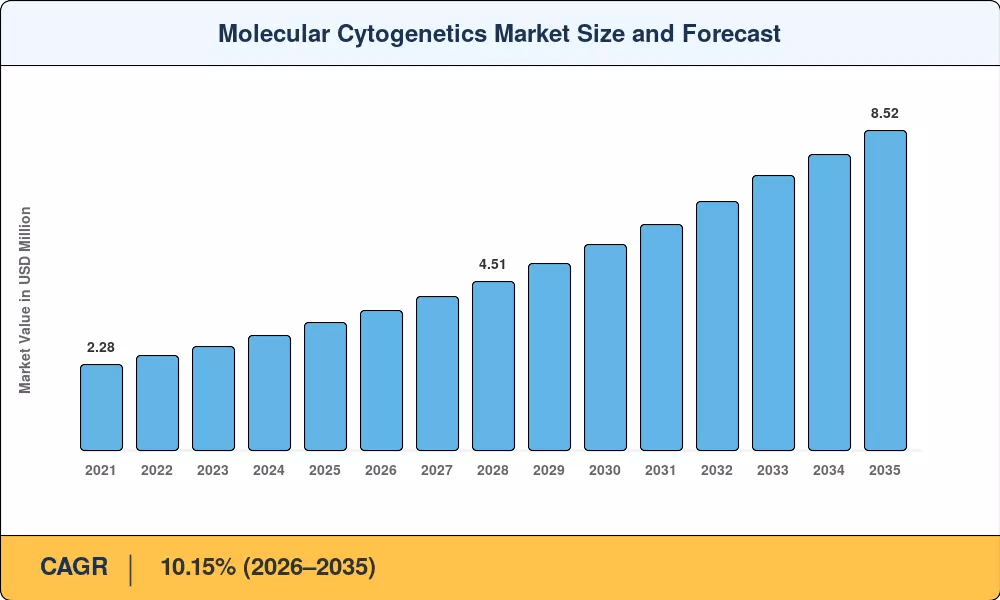
Molecular Cytogenetics Market Size
Molecular Cytogenetics Market to Surge from USD 3.72 Billion in 2026 to USD 8.52 Billion by 2035-Powered by FDA Accelerated FISH Panel Clearance,
NY, CA, UNITED STATES, June 11, 2026 /EINPresswire.com/ -- As per Market Research Future, the global Molecular Cytogenetics Market size to reach USD 8.52 Billion by 2035 from USD 3.72 Billion in 2026, at a CAGR of 10.15% during the forecast period 2026--2035. The market base was estimated at USD 3.40 Billion in 2025.The 10.15% CAGR---anchored by structural diagnostic demand rather than discretionary healthcare spending---is driven by three converging forces: FDA accelerated clearance pathways for next-generation chromosomal FISH analysis panels that continue to widen the addressable base, sustained Medicare reimbursement code expansion that has pulled oncology-linked cytogenetic laboratory testing into routine procurement cycles, and the technological shift from legacy banding-based karyotyping techniques toward automated array CGH diagnostics platforms and AI-driven image interpretation software that reduce manual labor and improve diagnostic throughput.
National governments and multilateral health organizations are amplifying this momentum. The National Institutes of Health allocated over USD 420 million toward genomic infrastructure modernization between 2023 and 2025, a program that directly accelerated the adoption of digital chromosomal abnormality detection workflows in hospital-based laboratories. The FDA finalized its sweeping regulatory framework regarding Laboratory Developed Tests (LDTs) in April 2024, dramatically shifting compliance oversight for all complex molecular cytogenetic assays. The WHO projects that AI-assisted cytogenetic laboratory testing could reduce diagnostic errors by 35--40% globally by 2030. Together, these initiatives are creating the procurement infrastructure and delivery innovation on which the Molecular Cytogenetics Market depends.
Request A Free Sample:
https://www.marketresearchfuture.com/sample_request/21573
Key Market Trends & Growth Drivers
FDA Accelerated Clearance and Medicare Reimbursement Expansion
Regulatory pathways increasingly favor streamlined in-vitro diagnostic review frameworks, with FDA updates lowering regulatory hurdles for novel probe sets to access the market. Novel chromosomal FISH analysis kit paths have been streamlined by FDA updates addressing contemporary in-vitro diagnostic review frameworks, lowering regulatory hurdles for novel probe sets to access the market. The addressable market across clinical laboratories has expanded concurrently with the expansion of public and private payer reimbursement codes for sophisticated molecular cytogenetic assays in oncology settings, which is a significant demand driver for the molecular cytogenetics industry.
CMS expanded bundled payment coverage for cytogenetic laboratory testing in oncology settings, covering FISH panel analysis and array CGH diagnostics for cancer patients. This policy shift is estimated to redirect significant annual spending toward advanced molecular cytogenetic products, pulling volume from traditional karyotyping techniques. The reimbursement change particularly benefits clinical laboratories, where chromosomal abnormality detection workflows now qualify for outpatient payment rates. Early-adopter health systems report that chromosomal FISH analysis delivers targeted results within 24--48 hours at a fraction of sequencing costs, making it preferable when specific rearrangements guide immediate therapy.
AI-Driven Karyotyping Automation and Cloud-Based Reporting
Legacy banding-based karyotyping techniques are steadily giving way to automated array CGH diagnostics platforms and AI-driven image interpretation software. Chromosomes must be segmented and examined under a microscope for a considerable amount of time by skilled cytogeneticists using traditional manual karyotyping methods. Deep neural networks are used in emerging AI-assisted software suites to produce initial karyogram recommendations in a fraction of that time, significantly reducing manual interaction while retaining high accuracy. This change directly solves the global scarcity of certified cytogeneticists while also significantly increasing laboratory throughput.
Cloud-based reporting systems now handle specimen volumes that would have overwhelmed manual karyotyping techniques just five years ago. Cloud-based SaaS services provide automated digital karyotyping and chromosomal segmentation through pay-per-case subscription pricing, removing heavy upfront capital hurdles. These agile software frameworks make it easier for mid-tier diagnostic centers in developing nations like Brazil, India, and Southeast Asia to enter the molecular cytogenetics industry by reducing the initial investment costs. The global software and services segment within the Molecular Cytogenetics Market is expanding at the fastest pace, driven by cloud-based karyotyping techniques, automation, and AI-enabled image analytics.
National Genomics Programs and Companion Diagnostic Integration
China's long-term healthcare infrastructure frameworks continue to support the growth of precision medicine, with a particular emphasis on increasing the capacity to detect chromosomal abnormalities in regional hospitals. India's Genome India Project has produced a strong genetic baseline that drives downstream demand for molecular cytogenetic validation reagents, kits, and training programs after successfully reaching its major milestone of sequencing 10,000 complete genomes. These national genomics mandates are transforming sporadic donor financing into steady multi-year demand for chromosomal FISH analysis and array CGH diagnostics.
Ask for Customization:
https://www.marketresearchfuture.com/ask_for_customize/21573
Market Segment Insights
BY PRODUCT
Kits & Reagents: Dominant segment with ~58% revenue share in 2025. Reflecting steady demand for consumables tied to chromosomal abnormality detection workflows. Every chromosomal FISH analysis or array CGH diagnostics run consumes proprietary probe sets and buffers, making this segment structurally durable through 2035. Abbott's Vysis CLL FISH Probe Kit and Agilent's SureFISH probes anchor this segment.
Software & Services: Fastest-growing product category at 13.10% CAGR (2026--2035). Cytogenetic laboratory testing platforms that integrate AI-assisted interpretation with cloud-based case management are converting one-time license fees into recurring subscription models. As per-device costs fall with scale, the addressable channel widens from reference laboratories to community hospitals and regional clinics.
Instruments: USD 0.68 Billion in 2025. Automation upgrades in high-throughput laboratories drive demand for array scanners, FISH imaging systems, and karyotyping workstations. Instrument manufacturers are increasingly bundling reagent contracts with hardware placements, locking in multi-year consumable revenue.
Consumables: Legacy segment; supporting reagents, buffers, and slide preparation materials. Recurring demand tied to instrument installed base.
BY TECHNIQUE
Fluorescence In Situ Hybridization (FISH): Dominant technique with ~62% revenue share in 2025. Reinforcing its role as the gold-standard chromosomal FISH analysis method. Rapid turnaround, probe specificity, and deep integration into companion diagnostic algorithms make this technique structurally durable through 2035.
Array Comparative Genomic Hybridization (aCGH): Fastest-growing technique at 16.90% CAGR (2026--2035). Fueled by rising prenatal and oncology array CGH diagnostics adoption. Whole-genome copy-number detection without cell culture makes aCGH preferable in constitutional genetics and prenatal settings where genome-wide coverage at a single-test cost outperforms sequential FISH panels.
Other Techniques: Emerging segment; spectral karyotyping and digital PCR methods represent incremental demand channels. USD 0.22 Billion in 2025.
BY APPLICATION
Cancer Testing: Dominant application with ~63% revenue share in 2025. Chromosomal abnormality detection is embedded in diagnostic and treatment-selection protocols for leukemia, lymphoma, and solid tumors. Mandatory companion diagnostic requirements ensure consistent, long-term reagent and assay usage worldwide.
Personalized Medicine: Fastest-growing application at 18.95% CAGR (2026--2035). Pharmacogenomic-guided therapy selection drives demand for chromosomal FISH analysis results that directly inform drug selection. The expanding targeted oncology pipeline creates a durable annuity of cytogenetic laboratory testing demand.
Genetic Disorders: Niche segment; newborn screening program expansion and prenatal screening drive demand. USD 0.52 Billion in 2025. Preimplantation genetic testing (PGT) and improved prenatal screening represent high-growth adjacencies.
BY END USER
Clinical & Research Laboratories: Largest segment at ~49% share in 2025. Core diagnostic workload and academic research grants dominate volume, channeling routine molecular cytogenetics supply. Processing the majority of chromosomal FISH analysis and array CGH diagnostics specimens.
Hospitals & Diagnostic Centers: USD 0.88 Billion in 2025, serving as the physical point of in-house cytogenetic laboratory testing programs and cancer diagnostics. In-house cytogenetic laboratory testing programs create dedicated procurement channels for chromosomal FISH analysis products.
Pharma, Biotech & CROs: Fastest-growing end-user segment at 14.90% CAGR. Embedding cytogenetic assays into clinical trial protocols and companion diagnostic submissions. Each approved therapy creates a durable annuity of cytogenetic laboratory testing demand tied to treatment initiation and resistance monitoring.
Academic Research Institutes: Emerging segment; genomic research and training programs. Government-funded genomics programs in China and India drive institutional procurement.
Read Detailed Insights:
https://www.marketresearchfuture.com/reports/molecular-cytogenetics-market-21573
Regional Outlook
North America -- Dominant Market (~40% Share, 2025)
The United States generates approximately 82% of North American Molecular Cytogenetics Market revenue, driven by broad commercial payer coverage, a dense network of CLIA-certified cytogenetic laboratories, and pharmaceutical-sponsored companion diagnostic programs---a single policy ecosystem that converted a research-dominated market into one with a structural clinical tail. The US dominates through a combination of Medicare reimbursement expansion for cytogenetic laboratory testing and FDA accelerated clearance pathways for FISH panels.
Canada contributes through provincial health authority investment in array CGH diagnostics at 10.52% CAGR, while Mexico is growing at steady pace on a growing private laboratory sector and oncology screening programs at USD 0.05 Billion in 2025. North America's leadership rests on reimbursement depth and the structural companion diagnostic segment created by expanded precision oncology pipelines.
Europe -- Second Largest (~27% Share, 2025)
Europe's Molecular Cytogenetics Market reflects divergent national strategies---Germany leads regionally with a strong university hospital network for chromosomal abnormality detection, contributing ~24% of regional share, while the UK historically used selective cytogenetic targeting before broadening coverage through the NHS Genomic Medicine Service, with over 400 hospitals now connected to centralized reporting platforms. France contributes USD 0.14 Billion through national cancer plan investment in cytogenetic laboratory testing. Italy contributes ~10% of regional share on public hospital modernization programs.
Harmonization pressure from EU IVDR requirements is gradually narrowing these differences, lifting baseline demand across the region while raising compliance costs for smaller players. The Nordic countries contribute USD 0.08 Billion on centralized biobank infrastructure at steady pace. Spain is growing at 9.70% CAGR on regional health authority adoption of array CGH diagnostics. Russia holds ~5% of regional share through federal oncology center build-out. The UK's NHS Genomic Medicine Service has become a model for integrating chromosomal FISH analysis into routine cancer care pathways.
Asia-Pacific -- Fastest-Growing Region (12.18% CAGR, 2026--2035)
Asia-Pacific is the engine of the Molecular Cytogenetics Market. China holds the largest regional share with ~38% of regional revenue, driven by the 14th Five-Year Plan genomics allocation and precision medicine infrastructure buildout creating large-volume procurement cycles for chromosomal FISH analysis consumables. India is growing at 13.85% CAGR on the back of the Genome India Project and growing private diagnostic chains operating 200+ collection centers, scaling array CGH diagnostics capacity at double-digit rates.
ASEAN economies show the steepest growth at 12.40% CAGR as hospital infrastructure expansion in Thailand and Indonesia converges with donor support. Japan contributes USD 0.16 Billion through aging demographics and oncology-linked cytogenetic laboratory testing at steady pace. South Korea holds ~12% of regional share on National Health Insurance coverage of karyotyping techniques. The rest of Asia-Pacific is growing on early-stage laboratory modernization. The region's combined contribution anchors the global volume base for chromosomal abnormality detection demand.
Middle East & Africa -- Emerging Opportunity (Steady Growth, 2026--2035)
The Middle East & Africa carries the widest infrastructure gap and therefore the steepest opportunity. Saudi Arabia leads the region with Vision 2030 healthcare transformation, contributing ~32% of regional share and dedicated funding for chromosomal abnormality detection infrastructure at newly commissioned oncology hospitals. The UAE is growing at 11.50% CAGR on Dubai and Abu Dhabi's genomics hub ambitions. South Africa contributes USD 0.02 Billion on National Health Laboratory Service expansion.
Egypt is growing at 10.20% CAGR on growing oncology patient volume. International aid-funded diagnostic programs underpin sub-Saharan demand across the rest of the region, contributing ~18% of regional share. Workforce scarcity remains a restraint---clinical laboratories often take three to six months to find qualified candidates for unfilled staff positions, and the recruitment pipeline is still limited since traditional karyotyping and microdissection need extensive, multi-year specialist training.
South America -- Growing Presence (USD 0.17 Billion, 2025)
Brazil anchors South America's Molecular Cytogenetics Market at ~62% of regional revenue, with the Unified Health System (SUS) incrementally adding cytogenetic laboratory testing to its reimbursed oncology diagnostic menu, creating a stable demand floor that smooths regional forecasts. Argentina is growing at 9.25% CAGR on university hospital laboratory upgrades.
The rest of South America is growing steadily on NGO-funded screening programs. South America's procurement runs largely through public health systems, which pool demand to secure competitive pricing. The region's stable demand base supports manufacturer volume planning even as per-unit tender prices compress margins. High capital cost of automated FISH platforms remains a barrier in resource-constrained areas.
Competitive Landscape and Recent Developments
The Molecular Cytogenetics Market is moderately concentrated, with an estimated Herfindahl-Hirschman Index in the 800--1,200 range and the top five suppliers holding roughly 48--55% of global revenue. Concentration is highest in high-income segments where regulatory and manufacturing barriers are steep; the emerging-market tier is more fragmented as regional producers compete on price.
The competitive landscape is stratified between premium platform providers serving clinical and research markets, high-volume reagent suppliers capturing hospital system tenders, and AI-software specialists consolidating the digital cytogenetics segment.
KEY COMPANIES AND RECENT MILESTONES
Abbott Laboratories (April 2022): Received FDA approval for its Vysis CLL FISH Probe Kit as a companion diagnostic to select targeted therapies for chronic lymphocytic leukemia, continuously reinforcing its comprehensive chromosomal FISH analysis menu. Broad oncology companion diagnostic portfolio anchors a strong North America franchise, holding ~10--14% of global revenue.
Agilent Technologies (2024--2025): Maintains leadership with Array CGH diagnostics microarrays and SureFISH probes, commanding ~9--12% of global Molecular Cytogenetics Market revenue. Genomics workflow integration leader serving clinical and research laboratories worldwide.
Illumina, Inc. (2024--2025): Expanded sequencing-adjacent cytogenomic solutions portfolio, reinforcing the platform ecosystem with clinical-grade arrays. Holding ~7--10% of global revenue. The company benefits from the structural companion diagnostic tail created by expanding precision oncology pipelines.
Thermo Fisher Scientific (2024--2025): Maintains FISH reagents and Applied Biosystems instruments portfolio, commanding ~6--9% of global revenue. End-to-end laboratory workflow coverage serves high-throughput cytogenetic laboratories globally.
Future Outlook: 2026--2035
By 2030, AI-augmented chromosomal analysis will become the operating system of cytogenetic diagnostics. Machine learning algorithms trained on millions of annotated karyotypes are approaching --- and in some benchmarks exceeding --- expert-level accuracy for chromosomal abnormality detection. The WHO projects that AI-assisted cytogenetic laboratory testing could reduce diagnostic errors by 35--40% globally by 2030, a leap that would strengthen clinician confidence in automated reporting and accelerate adoption across the Molecular Cytogenetics Market. These platforms create a streamlined "digital front door" that enhances the triage process for antimicrobial wound therapy prescriptions.
Platform consolidation and ecosystem economics will reframe cost structures by the early 2030s. Integrated platform providers that combine instruments, reagents, software, and cloud connectivity are gaining share at the expense of single-product vendors. This platform economics model mirrors trends in clinical chemistry and immunoassay markets, where bundled contracts now represent over 70% of laboratory procurement. The Molecular Cytogenetics Market is following the same consolidation arc, with top-five players expected to control over 55% of global revenue by 2032. As per-device costs fall with scale, the addressable channel widens from reference laboratories to community hospitals and regional clinics.
More Related Research Insights:
https://www.marketresearchfuture.com/reports/molecular-diagnostics-market-1171
https://www.marketresearchfuture.com/reports/genetic-testing-market-2009
https://www.marketresearchfuture.com/reports/next-generation-sequencing-market-6354
https://www.marketresearchfuture.com/reports/companion-diagnostic-market-3077
https://www.marketresearchfuture.com/reports/cancer-diagnostics-market-1962
https://www.marketresearchfuture.com/reports/personalized-medicine-market-2937
https://www.marketresearchfuture.com/reports/genomics-market-12283
https://www.marketresearchfuture.com/reports/fluorescent-in-situ-hybridization-fish-probe-market-27578
https://www.marketresearchfuture.com/reports/biomarker-market-1941
Larry Wilson
WantStats Research And Media Pvt. Ltd.
+1 855-661-4441
email us here
Visit us on social media:
LinkedIn
Facebook
YouTube
X
Legal Disclaimer:
EIN Presswire provides this news content "as is" without warranty of any kind. We do not accept any responsibility or liability for the accuracy, content, images, videos, licenses, completeness, legality, or reliability of the information contained in this article. If you have any complaints or copyright issues related to this article, kindly contact the author above.
